Showing posts with label Current affairs. Show all posts

Sunday, January 10, 2010

News and media in Norway

The decline of serious media is something that has been widely commented upon. Traditional media like newspapers and television have a hard time making a profit, and many turn towards a more "tabloidism". They shy away from serious news coverage and fill up their pages and time with pure entertainment. In that respect the willingness of the state-owned TV-channel NRK to do the opposite is truly laudable.

The quality of NRKs news coverage was already great as it was - serious and balanced - and it has had some really great docu-mentaries and programs on current affairs, especially Urix, a program analyzing various foreign affairs/current affairs topics. Now NRK is stepping this up even more, with more time for news and more debate-programs. One of the most promising "newbies" is Supernytt, which is basically news for kids. It takes guts to launch something like that, and I doubt that any commercial channel would have made such a gamble.

This increased focus on serious news and debate is especially welcome because Norway is in my opinion not rife with such. Granted, we do have a great national broadcaster in NRK, and it's main competitor, TV2 does have a dedicated channel to news - kind of like a Norwegian national mini-version of CNN. And we do have some relatively high quality national newspapers. Norway has a highly educated population and a high proportion of newspaper readers. But we are very few, there are only 4,6 millions of us. And in such a tiny market it is infernally hard to run any commercial tv channel or newspaper economically profitable in the same way you could in a larger market like Germany, the UK or even France. So even though we do have some good newspapers (like Dagsavisen and Dagens næringsliv), we do not have anything that is even close to newspapers like Daily Telegraph, The Times, Süddeutsche Zeitung, etc.

That is all fair enough though, given the way things are. But what is more lamentable or annoying or whatever, is that in parts of the country (where I live now for example), the good newspapers are not on regular sale. By that I mean that to get them, you will have to subscribe, which I did for a while, but then you will only get them a day or two late. So what we are left with if we want to read the paper version of newspapers are VG and Dagbladet, which are (in my opinion) crap and a waste of time to read.

Anyway. Ari Fleischer, George Bush Jr.'s press secretary, complained that the press always ended stories on a down-note, to point out something negative no matter how positive the main story was. I don't want to do that, since what I meant to do with this post was to praise NRK for what they are doing, which is truly great. So let me just end this by saying: Way to go, NRK!

Sunday, February 22, 2009

Beware of Islamic oppression of the Samis!

Anyone following the Norwegian news the last couple of weeks could not have escaped to notice the debate about whether or not to allow the hijab in the police force. Some arguments in favor of allowing it has been presented, and many good ones against. The blogger Knut Johannessen is presenting some of them in two postings on his blog Voxpopuli, titled Tilslørte politipiker and It's not the hijab, stupid!. On Wednesday this week one of the most bizarre arguments in this debate was heard.

In the February 18 issue of the local newspaper Finnmarken, the Sami politician Jánoš Trosten claims that allowing the hijab will lead to a renewed oppression of the Sami people. As much as I agree with mr Trosten not to allow wearing the hijab with a police uniform (or with an army or any kind of official uniform for that matter), his reasoning must be one of the most ridiculous ever. According to him, the hijab must be prohibited for the reason that the Sami community will not be able to handle the islamification this would inevitably lead to. Foreign customs like this are a grave threat to "an already weakened culture," which is still suffering from the Norwegianification processes in the 18th, 19th and early 20th centuries.

Seriously, even in the case that his premises were true - how many female muslim cops does mr Trosten think would find their way up to Kautokeino and Karasjok in the case of an acceptance of the hijab in the police force?!? What would make us believe that the Sapmi area suddenly would experience a massive influx of hijab wearing female police officers? It beats me, but mr Trosten apparently believes that would be a probably scenario..

Mr Trosten, whom I mentioned in my post of 19 March 2008 titled Separatism in Norway, pt 2, is known to be among the more extreme of Sami politicians, if not the most extreme. Upliftingly, he seems to be quite alone in his fear that the hijab poses a large threat to the Samis and their culture. Several other notable politicians, such as president and vice presidents of the Sami parliament mr Egil Olli and mrs Marianne Balto, as well as former president of the Parliament mrs Aili Keskitalo, do not have any such fear.

As for mr Trosten's claims that the Sami culture is under any kind of threat in Norway, anyone living in Finnmark would take that with more than one grain of salt. The Norwegian policies towards Samis basically up to the mid-20th century were unfortunate and inexcusable. But with the massive revival of Sami culture and increased political power especially after the 1980s, you could not correctly claim that the Sami culture today is in any way weakened or threatened. As you could read into the post Separatism in Norway, pt. 2, some would say almost on the contrary.

Sunday, February 15, 2009

Eavesdropping neighbors

So, it seems that our Swedish neighbors are eavesdropping on us. Listening on our phone calls and reading our emails. With the so called FRA act or FRA law, the Swedish government is at least given the opportunity to do so. Effective from January 1 2009, the act authorizes the state to wiretap all telephone and Internet traffic that crosses Sweden's borders without any individual warrant to do so.

Not surprisingly, this act is part of anti-terrorism legislation, seeking to protect Swedish citizens by stopping terrorist activity and plotting leading up to a strike. But the legislation has - also not surprisingly - run into a wall of criticism, with some commentators predicting the fall of Prime Minister Fredrik Reinfeldt. Basically all major newspapers in Sweden have spoken out against the legislation. Even though the wiretapping is only intended for communication running across the border, some critics say it is in practice impossible to differentiate between international calls and calls between Swedish citizens. Also, the international criticism is stark: the Finnish government has sent an official protest to the Swedes.

Here in Norway, many are speaking up against the law, but the Government has not as of yet sent any official protest. Mainly Venstre (the Left Party) is speaking up, saying the Government is too passive and demanding some action and protest against the act. The act is negating Norwegians' and other non-Swedes' rights with regards to surveillance. Also, Norwegian business is being affected by the law and the surveillance of their activity. Recently, the Norwegian branch of the International Commission of Legal Professionals has filed a suit against the Swedish State at the Human Rights Court in Strasbourg. This has been widely supported in Norway.

This issue digs right into that post 9-11 debate of wether we should allow some infringement on our rights for the State to be better able to protect us against terrorists. As many, among them mr Barack Obama, have pointed out, this is a false choice. In the fight against terrorism, these are the rights and values we should be protecting, not limiting. By broadening the State's surveillance of citizens, we are heading the wrong way: towards an East German Stasi system where anyone the least bit suspect in the State's eyes (i.e. everyone) was secretly wiretapped with thick and growing folders filling up Government file-cabinets, just in case they might be up to something..

Friday, December 12, 2008

Political ads allowed on TV

Not very long ago, I wrote a post about political advertising on TV in Norway. During the three weeks since then, things have surely happened.

Despite political ads on tv being prohibited, the small local tv station TV Vest ran three ads for the local branch of the Pensioners Party in 2003. As a result, they were fined 35.000 NOK (roughly €4.500). This they refused to pay on principal grounds and took the case to the Courts of Human Rights in Strasbourg. They claim that the ban is an offense against the rights of free speech. Yesterday, the Court decided in favour of the TV-station. So, the way things are looking, political advertising is in principle allowed...

Interestingly, the British TV station Channel S was fined £40.000 on Wednesday this week for having run a total of 44 political ads for the Liberal Democrats. Also somewhat curious is that this case and the verdict has received very scarce attention in international media.

Check out the blog Word From the North for an interesting post about the ban, the case and the verdict.

Friday, November 21, 2008

Harr harr! - modern day pirates

Since I was a kid, I've been fascinated with pirates. I used to love reading about them. One of my favorite stories was about the famous pirate Edward Teach. Teach, better known as Blackbeard, fired up pieces of hemp in his beard to seem more fearful and demon-like to his enemies. Buccaneers, Swashbucklers and Privateers, hmmm, those must have been the days.. Since I've started blogging, I haven't really seen any natural opportunity to write anything about pirates. But now, with all the buzz in the media about pirates, I'm not going to relinquish on the chance to finally comment on piracy!

The last year or couple of years, the coast off Somalia and around the bay of Aden has become a real hot-bed for piracy, and a real hazard for ships passing through. The last year, pirate assaults off the east coast of Africa has increased by 75%. Just this week, on Thursday, a band of Somali pirates demanded a ransom of 25 million US dollars for the Aramco-owned oil tanker Sirius Star. And on Tuesday this week, a Greek cargo ship with a crew of 20-odd was also caught by Somali pirates.

The piracy in this area is a scourge for the shipping industry, and has forced several shipping companies to send tankers and cargo ships travelling between Asia and Europe around the Cape Good Hope instead of through the Suez Canal as they will have to pass through the bay of Aden the get there. One of those is the Norwegian company Odfjell, which weekly has got 2-3 ships passing through this area. For Odfjell this is a decision based on the crews safety, and will imply a large jump in costs due to the increased distance to be travelled.

The Norwegian Union of Ship-Owners (norsk rederiforbund) is frustrated that not enough is being done to rid this and other areas of piracy. The Union wants the Norwegian government to deploy military forces in the area to combat pirates. That might well be done, as the navy recently has been training on pirate-combating tactics. But even if Norway contributed to an international force, this would have to be huge, as the area in question is enormous - 6.6 million square kilometers. And also, of course the growth of piracy has its roots in the conditions in conflict-ridden Somalia itself. Without bettering the conditions in the country, solving the piracy-problem might be near impossible.

Sunday, November 9, 2008

About a road..

I have moved back to Norway. Back to my home town up in the cold, high north - the district of Finnmark. And that is the main reason that no posts have appeared the last couple of weeks. Even though I started this blog as a way to keep myself somehow informed and mentally occupied with things happening back home when I was living abroad, I will continue along the same lines from inside of Norway. In a way, it might be more a view from "the inside." But Finnmark is far far away from the more densely populated south, so it will be in some ways a view from afar still..

Since I have moved up here, it might be appropriate that I start out with a current issue from Finnmark - the controversies about a road being built to an even more remote and smaller village than the one that I am living in. The issue touches on an issue that I have brushed on before, the relationship between Samis and non-Samis.

The tiny village of Nervei has long been without any proper road connecting it to "the rest" of the world, but has relied on a ferry arriving from time to time. Not being quite happy with that, understandably, the people of Nervei has done a great job in collecting money and organizing the building of a road of about 20 km themselves, the work on which is going on now.

The problem with the road and the work arises partly from the fact that the road runs through land that is used as grazing lands for reindeer. So, Reindeer Grazing District Number 13 has taken this to court trying to get the roadworks stopped, or alternatively and much better to get some economic compensation. This issue really exemplifies that old joke that the two Norwegian terms that the Samis bother to learn are "our Sami rights" and "compensation." Many non-Samis see this whole story as a Sami knee-jerk reflex to get even more compensation.

The reindeer-herding Samis do rely on lands all over Finnmark for grazing, and some of their claims are legitimate. The lands are not very fertile, and are easily grazed down. Thus, herding the reindeer around is essential both to feed them and to avoid damaging the lands used for grazing. But in this particular situation, their claims ring terribly hollow. We are talking about an improvement of an already existing tractor trail, which means it is not a case of destroying any grazable areas. And it is also not a case of a heavily trafficked road that will disturb the reindeer.

Personally I think issues like this, where a small part of the Sami reindeer-farmers are trying to exert their influence to wring some more compensation out of the State coffers, are having a detrimental effect on the relationship between Samis and non-Samis in Finnmark. Non-Samis are being annoyed and aggravated over what they perceive as exerting their power just for the sake of it.

For more information about this road, take a look at this blog (in Norwegian: På vei til Nervei

Thursday, October 16, 2008

Worries in the High North

In this week's issue, the Economist is featuring an article that highlights Russia's conduct in the Arctic areas. It describes this area, "cold, empty and rich in fish and minerals", as "a tempting prize for a big, confident country." Russian fighter jets have been frequently flying very close to Norwegian territory, something that while not illegal sends some worrying signals. The recent €4 billion emergency loan to Iceland is also a bit worrying - not in itself, but with regards to whatever Russia wants in return.

I have written some posts about this issue already; "The Bear and Us - Russia and Norway" and "The Bear and Us Revisited". My point in those articles was that although the Cold War is over, we should be very wary with regards to our Eastern neighbor.

As a tiny little country of only four and a half million people we are not in an ideal position if we should get into a conflict with Russia. But we still need to do everything in our power to stand our ground, and send clear signals of our own standpoint. Also, as I see it, we have no other choice than to keep both of our feet firmly grounded in NATO. It may be pointed out that "NATO presence is fitful" in the High North, as the Economist does. Still, it is a grave mistake to argue for us to distance ourselves from NATO and our Western allies, as some of our socialist parties do. We cannot afford to stand alone, and NATO is our best bet not to do so.

It has been sad to see that even our dear former Prime Minister, Haakon Lie, has been arguing against taking our share of responsibilities in NATO operations around the world. His rhetorical point is that Norway's borders are not running next to Afghanistan. That is of course true. But it is equally true that most NATO members do not have a border to Russia along the Pasvik River in Northern Norway.

Thursday, September 25, 2008

The Kauhajoki massacre

The school massacre in Kauhajoki this week has left Finland and the rest of Scandinavia in a state of shock and disbelief. It is hard to fathom what lead 22 years old Matti Juhani Saari to gun down nine of his fellow students and one teacher before putting the gun to his own head.

There has been many explanations put forth for this tragic episode. As expected, the usual suspects, the internet and Finland's lax gun laws have been pointed to first. Saari was very active on the internet, where he showed a very keen interest in guns. And unlike from his normal contact with other people, he also showed his darker sides on the net. On example of this is the video clips he put out on YouTube shortly before the shootings. Partly due to Finland's hunting traditions, obtaining a gun is very easy in Finland.

Hege Ulstein of Dagsavisen has also pointed to Finland's school system as one of the culprits. Finland has received much praise for its high results in international surveys and tests, such as the PISA-tests. Her argument is that because Finland does not prioritize social skills training as much as Norway, Finland would be more prone to such tragedies. This is a highly speculative argument in my mind.

It is true that the Norwegian syllabus contains a very high emphasis on social skills, which is very good. Whether it succeeds to reach the goals could be discussed, but the emphasis is nevertheless important. To argue that because we put focus on social skills that we are immune to such tragedies is highly dubious. We only need to think back a couple of months to find an incident that could have turned really nasty, when a barrister fired a gun into a reception center for asylum seekers and seriously injured a 16 years old Somalian. Fortunately, we have been spared of tragedies of the scope of the Kauhajoki massacre (knock on wood). But to hold that we for various reasons are somehow immune to that would be to fool ourselves.

Sunday, August 17, 2008

The Norwegian Islamic Council and Gays

The Norwegian minister of social equality, Anniken Huitfeldt, threatened to withdraw the goverment financial support for the Norwegian Islamic Council last week, after the council showed itself unwilling to mark its distance towards capital punishment for homosexuality. The council is awaiting advice from the European Fatwa Council before they will take a stand on the issue of capital punishment for homosexuality. The Norwegian Islamic Council receives around half a million Norwegian Crowns (appr. 62.500€) annually in government support.
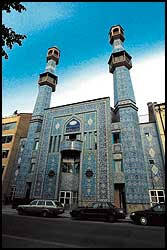
One might discuss the issue of whether the State should give any financial support at all religious institutions at all, even the State Church. Especially if the Norwegian state purports to be a secular state, that would be a relevant topic to discuss. And since we do subsidize the State Church, why not support other faiths, especially the ones that a large part of the Norwegian population belongs to? Personally, I am a bit skeptical to the idea that we should spend public money on religious organizations, whether they be Muslim, Christian, Jewish, Buddhist, or anything else, even when it comes to such small amounts as 500.000 NOK.

But since we do in fact subsidize religious institutions with government money, that leads to the question of to what extent it should be expected that the recipients of financial support aligns itself to what is acceptable viewpoints. You could argue that the Islamic Council is free to express whatever viewpoints it choose, as long as it respects Norwegian legislation. On the other hand, its viewpoints might influence the attitudes of its members, and that as long as they receive government support, they need to adhere to some basic values that we base our society on. In either case, to abolish any kind of financial support for such institutions would eliminate that problem altogether.

The issue of the Islamic Council's stance on homosexuality has raised a hefty amount of debate. Reading through the comments on some of the articles in various online newspapers, I must say that I am slightly taken aback by a large part of those comments. Judging from the comments, the level of antagonism towards the Islamic Council itself and towards Muslims in general seems to be quite high. Now, it's probably mostly those that are emotionally involved that bother to post their comments, so its fair to argue that those do not give a representative overview of the Norwegian people's general opinion. Nevertheless, it is clear that there is a great deal of animosity towards the Muslim population because of this issue.

I find it truly tasteless to express the view that homosexuality should be punished by death - just as much as it is tasteless to express the views that Jews should be annihilated, that women's rightful place is in the kitchen, or that people of different skin colors are of lesser intellect than whites. Still, not all, even most, of Norwegian Muslims hold the view that homosexuals should be stoned to death. And we also need to be aware that many Christians hold fundamentalist views on many issues, such as homosexuality. Religious texts are after all interpreted in the context of our society. If you read the Bible to it's literal meaning (or what you believe it's literal meaning to be), you could find many a place where it will be incompatible with our modern society. The same goes for the Quran.

That homosexuality is to be punished by death, or that women should be wrapped up in burkas, or that a sister who does something the brother does not approve of needs to be killed in order that the family not lose their honor is just abhorrent. But you could argue - and I do that - that such viewpoints are more the expressions and norms of a culture than the religion as such. It is perfectly possible to be a liberal and progressive Muslim, just as much as it is possible to be a liberal and progressive Christian. Still, there is no doubt that some in the muslim community hold views that are unmodern and barbaric.

The Western culture have some values that we should be very proud of, such as equality, freedom of speech, and tolerance for others that are different from ourselves. Those are values that we should stand up for and fight for. And we should try our best to spread and foster those values in our society. We can punish people who break the law, but to have the "wrong" values is not a punishable offense in itself - we cannot force people to hold the "right" values. That is actually one of our values - that people can believe what they will. We can - and should - try to convince others that our set of values on the whole are right and good, but that needs be done with reason, debate and open discussion, not by trying to deny others the right to hold values that we ourselves believe are wrong.