Saturday, August 23, 2008

The Christian People's Party and Gays

The politician Ole Henrik Grønn in the Sarpsborg Christian People's Party (KrF) resigned his position with the party last week. His resignation is due to the stark criticism he has been at the receiving end for because of his sexual orientation. According to the leader of the local party, Marit Sverresen, Grønn's position in the party is incompatible with living in a relationship with another man.

As I stated in my August 17 post, The Norwegian Islamic Council and Gays, reactionary attitudes are not at all reserved for Muslims or any other religious faith. It is a sliding scale, of course, and barring certain people for membership in a political party is not the same as punishing them with execution. The similarities are nevertheless obvious.

If we want to force the Norwegian Islamic Council to hold certain views and values that we find politically correct, why not also impose the same on our political parties? Anything else is in my opinion pure hypocrisy.

Friday, August 22, 2008

The Bear and Us Revisited

With Russia's invasion of Georgia, we are again reminded of our neighbor's aggressive streaks. And those who thought that Post-Putin Russia would be much different are proved wrong.

Since the end of the Cold War, the military bases in Northern Norway have been steadily built down, and the number of troop stationed has been reduced. Suddenly that build-down might not seem like such a good idea. After having downsized our military capabilities, it will take a lot longer to rebuild them than the downsizing took. It will also potentially run into greater political resistance than if we had maintained them, and the signals it will send to our neighbors (i.e mainly Russia) will be very strong.

But the recent developments should illustrate that we do need a military defense. We can not show goodwill by abandoning the few means we do have to protect ourselves, and naively hope that our neighbor will behave as good in the future that it has so far. The Soviet days are over, and so is the Cold War, thank God. But Russia is still Russia, and it has shown an ugly urge to make up for lost prestige by bullying and intimidating its neighbors. And what's worse is that these policies have broad support in the Russian population.

Although we should never give up our efforts to maintain and further improve the good relationship we have with Russia, we also need to keep firmly in mind that our defense should be closely tied to NATO and the West.

Of course, the danger that we might get into a conflict with Russia is not imminent, and the difference between Norway and Georgia in this respect is vast. But the remoteness of war has been misjudged before; at the 100-year anniversary for our constitution in 1914, the Prime Minister Gunnar Knudsen described the international political sky as as clear as it hadn't been in many, many years. A few months later the entire world was thrown into the worst conflict the human race had seen. So even though the prospects for conflict might be remote, the risks of ignoring them are potentially huge.

Sunday, August 17, 2008

The Norwegian Islamic Council and Gays

The Norwegian minister of social equality, Anniken Huitfeldt, threatened to withdraw the goverment financial support for the Norwegian Islamic Council last week, after the council showed itself unwilling to mark its distance towards capital punishment for homosexuality. The council is awaiting advice from the European Fatwa Council before they will take a stand on the issue of capital punishment for homosexuality. The Norwegian Islamic Council receives around half a million Norwegian Crowns (appr. 62.500€) annually in government support.
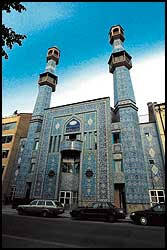
One might discuss the issue of whether the State should give any financial support at all religious institutions at all, even the State Church. Especially if the Norwegian state purports to be a secular state, that would be a relevant topic to discuss. And since we do subsidize the State Church, why not support other faiths, especially the ones that a large part of the Norwegian population belongs to? Personally, I am a bit skeptical to the idea that we should spend public money on religious organizations, whether they be Muslim, Christian, Jewish, Buddhist, or anything else, even when it comes to such small amounts as 500.000 NOK.

But since we do in fact subsidize religious institutions with government money, that leads to the question of to what extent it should be expected that the recipients of financial support aligns itself to what is acceptable viewpoints. You could argue that the Islamic Council is free to express whatever viewpoints it choose, as long as it respects Norwegian legislation. On the other hand, its viewpoints might influence the attitudes of its members, and that as long as they receive government support, they need to adhere to some basic values that we base our society on. In either case, to abolish any kind of financial support for such institutions would eliminate that problem altogether.

The issue of the Islamic Council's stance on homosexuality has raised a hefty amount of debate. Reading through the comments on some of the articles in various online newspapers, I must say that I am slightly taken aback by a large part of those comments. Judging from the comments, the level of antagonism towards the Islamic Council itself and towards Muslims in general seems to be quite high. Now, it's probably mostly those that are emotionally involved that bother to post their comments, so its fair to argue that those do not give a representative overview of the Norwegian people's general opinion. Nevertheless, it is clear that there is a great deal of animosity towards the Muslim population because of this issue.

I find it truly tasteless to express the view that homosexuality should be punished by death - just as much as it is tasteless to express the views that Jews should be annihilated, that women's rightful place is in the kitchen, or that people of different skin colors are of lesser intellect than whites. Still, not all, even most, of Norwegian Muslims hold the view that homosexuals should be stoned to death. And we also need to be aware that many Christians hold fundamentalist views on many issues, such as homosexuality. Religious texts are after all interpreted in the context of our society. If you read the Bible to it's literal meaning (or what you believe it's literal meaning to be), you could find many a place where it will be incompatible with our modern society. The same goes for the Quran.

That homosexuality is to be punished by death, or that women should be wrapped up in burkas, or that a sister who does something the brother does not approve of needs to be killed in order that the family not lose their honor is just abhorrent. But you could argue - and I do that - that such viewpoints are more the expressions and norms of a culture than the religion as such. It is perfectly possible to be a liberal and progressive Muslim, just as much as it is possible to be a liberal and progressive Christian. Still, there is no doubt that some in the muslim community hold views that are unmodern and barbaric.

The Western culture have some values that we should be very proud of, such as equality, freedom of speech, and tolerance for others that are different from ourselves. Those are values that we should stand up for and fight for. And we should try our best to spread and foster those values in our society. We can punish people who break the law, but to have the "wrong" values is not a punishable offense in itself - we cannot force people to hold the "right" values. That is actually one of our values - that people can believe what they will. We can - and should - try to convince others that our set of values on the whole are right and good, but that needs be done with reason, debate and open discussion, not by trying to deny others the right to hold values that we ourselves believe are wrong.

Friday, August 8, 2008

Rollo the Viking

A couple of months ago, I wrote a post about Scandinavian Vikings and their influence on the British Isles. In that post, I mentioned the great viking Rollo or Gange-Rolf, without going into any detail about him. I'll pick up on that here. Given that Rollo is the ancestor of among others the present-day British royal family, he is arguably one of the most influential Scandinavians of all time. He was also one of the Norsemen causing the most trouble on the European continent.

The exact origin of Rollo is a matter of dispute, and has been subject to heated debate between Norwegian and Danish historians. According to some Danish historians as well as the Norman historian Dudo of Saint-Quentin, Rollo was a Danish viking, son of a certain King Erik. According to the Icelandic historian Snorre Sturlason, he was son of the Earl of Møre in Western Norway, Ragnvald Øysteinsson. As the good Norwegian I am, I will go with Snorre's account, although I acknowledge that it is probably impossible to settle the matter of his origin.

As many others of his contemporaries, Rolf was only a young boy when he participated on his first viking raids. Only 13 years old he would take part in raids on the areas eastwards, around the Baltic Sea. The young Rolf kept participating in these raids for several years, until in his early 20s his group did a raid in the Viken-area, i.e. the area around the Oslo-fjord. King Harald Fairhair had explicitly prohibited the Norse from raiding inland, and this raid led to Rolf being exiled from Norway. The fact that Rolf was the son of the Earl of Møre, Ragnvald Øysteinsson, one of King Harald Fairhair's closest friends and allies, did nothing to stop Harald from exiling him. Neither did the pleading of Rolf's mother to the King.

After being exiled from Norway, Rolf traveled to the Orkneys and the Hebrides. In 885 Rolf joined the attacks on the area around Paris under the Danish viking leader Sigfred. Sigfred and his company must have posed a grave danger for the settlements in this area, for they were being bought off and paid tribute several times to cease the raiding. However, the raids lasted for several years, and Rolf slowly made himself chieftain of these vikings.

Only in 911 were Rolf's forces defeated by Charles the Simple at the Battle of Chartres. Instead of turning Rolf away, Charles decided to make Rolf his ally. With the Treaty of Saint-Clair-sur-Epte, Rolf pledged allegiance to the King, who gave him the areas that became known as Normandy. Rollo, as he was known from now on, would be Charles' first bulwark against any other vikings launching attacks on the Frankish areas.

Contrary to his pledges to Charles, Rollo did not stop his raids. From their base in Rouen, Rollo and his chieftains launched several raids on the surrounding area, constantly expanding their territory. In time they came to control a large area of what is now western France, their territory reaching as far west as the the river Vire. A few years before his death, Rollo passed on his fiefdom to his son William Longsword in 829.

Rollo must have been an imposing figure - according to Snorre, he was so large that no horse could carry him. Although Snorre no doubt was exaggerating this quite a bit, Rolf's physical size earned him the nickname of Gangerolf or Rolf the Walker. He also seems to have been a very proud person. According to legend, when he was to kiss King Charles' foot as part of the Treaty of of Saint-Clair-sur-Epte, Rolf flat out refused to do this. When Charles extended his foot to him, Rolf ordered one of his men to kiss it in his place. Rolf's warrior then lifted Charles foot up to his mouth, causing the king to fall over backwards.

Wednesday, July 30, 2008

Some reflections on Norwegian farming

The other day, I read an article in Dagsavisen about the different views of the Norwegian political parties with respect to the Norwegian agriculture. The Right wants to stop most subsidies to Norwegian farmers and thus force them to compete with agricultural products from abroad. The Left, on the other side, wants to keep the extensive subsidies and protect the farmers from foreign competition.

I tend to hold the view that the Norwegian farming is not competitive, and that we should not artificially keep it alive with high levels of subsidies and high tariff-barriers. A near arctic environment can hardly be said to be ideal for farming. Why should the taxpayers pay the salaries for a few individuals who want to cling on to something that's not at all able to compete with agriculture in other more suitable areas?

Also, it would be much fairer towards developing countries, e.g. in Africa, if we would truly open ourselves to real free-trade instead of building tariff-barriers to keep those countries from selling their produce to us. That could enable many poor farmers in developing countries to build better lives for themselves. It is inherently unfair the way that we are shutting these farmers out of our markets, and insisting that they need to open up for us to sell our products to them.

In addition to that, the world would be better off if we were to concentrate on areas where we are able to compete, and let countries with suitable climates concentrate on agriculture. That is what is called comparative advantage - we should all do what we do or can do best, and then trade fairly with one another. That will lead to products of better quality, made faster, and in greater amounts.

But - and this is a very weighty but - there are two other factors in the equation. Firstly, there is a food shortage coming. With growing populations, some have estimated that global food production needs to be doubled or tripled in the next 40-50 years. That taken into account, it might not be so desirable to pull the plug on the Norwegian agriculture and let it die. Maybe, in the long run, it would be wise to keep it alive for a while.

The other thing is that if the global warming continues, which in all probability it will, this would lead to the Norwegian climate becoming more suitable for farming than it is now. And thus, in a few years, the Norwegian farming might become a lot more competitive than what is now the case.

I guess the bottom line is that, as with many other issues, this is a difficult one, and it's not easy to say what's the right thing to do. As one of the richest countries in the world, such mercantilistic policies are in any case simply unethical. And the subsidies and tariff-barriers need to be lowered, even though that means that some farmers will be forced out of business. Farms being shut down is not an irreversible process. When or if the Norwegian climate will become more favorable, agriculture will inevitably grow even though it temporarily shrinks.

Wednesday, July 23, 2008

Some thoughts on alcohol..

It can be no doubt that the Norwegian alcohol laws are quite strict. Alcohol is generally very expensive, it is only sold at certain times, and stronger alcohols such as spirits and even wine are sold only through special alcohol outlets (Vinmonopolet). Also, in traffic, there is a zero-tolerance towards alcohol.

This stands out in stark contrast to the country where I currently live, the UK. Here alcohol is sold any time, at low prices, and even heavily discounted. Very often, the person behind the counter in the corner shop will inform you that there is a 8 cans of beer for 6 pounds offer if you pick a less cheap alternative from the shelf. And what's more; you will often see people getting behind the steering wheel after a drink or two.

A couple of years ago, I spent a year in Germany as an exchange student. During that time, I got into the habit of drinking wine with my dinner at night. Coming back to Norway, I got a little annoyed when I "re-discovered" that wine is not sold in regular grocery-shops. To get yourself a bottle of wine for dinner, you'll have to go to the alcohol-outlet. I do still think that is a little over the top; why making getting a bottle of wine such a hassle? But having seen all the problems with alcohol here in the UK, I think the Norwegian alcohol legislation is mainly a good thing. There is a clear correlation between price and availability, and consumption - making alcohol less readily available reduces consumption. Alcohol (and stronger alcohols in particular) should be rather expensive and not too easy to get hold of.

Of course, alcohol abuse is a complex problem, both on an individual level and sociologically. As the drunkard Jeppe said in Ludvig Holbergs play Jeppe on the Hill, "Everyone says that Jeppe drinks, but no one asks why". To be sure, even with very strict alcohol legislation, a lot of Norwegians get pissed out of their brains too. But compared to the Brits, that's Sunday school. And it certainly would not help to reduce alcohol consumption to make it cheaper and more available.

Another aspect of it is that the legislation is helping to shape the norms and attitudes towards alcohol. For me, it would be almost unthinkable to get behind the wheel and drive after even only one beer. I think that goes for most Norwegians. Drinking and driving does not go together, full stop. That attitude is greatly helped by the strict non-tolerance laws when it comes to alcohol and driving.

I do not mean to present Norwegians as particularly good drinkers - we certainly are not. Many Norwegians drink too much and too often. The steep prices on alcohol (particularly in bars and discos) makes us drink more before we hit the town, so that we won't have to drink so much after going out. This of course just makes us drunker earlier in the evening. But having seen the attitudes towards alcohol here in the UK have made me a little more wary towards the problems associated with alcohol, and I would not want Norway to resemble the UK any more than we already do in this respect.

Wednesday, July 2, 2008

Scandinavian Gentlemen?

In this post, I would like to pick up the lead from one of my May posts, "Norwegian "politeness"", and continue on that. The other day, I had a little discussion with some of my colleagues at work about gentlemen. It might be said that we Scandinavians are not truly behaving like gentlemen, at least not in the classical sense - e.g. like a Frenchman. We often don't help the women put on their coats, hold their chairs, open the doors for them, etc. - all the things that would be expected from the classical gentleman.

Personally, I think the 1970s did a great deal of harm to the concept of being a gentleman in Norway. That probably holds true in some other countries as well. The 70s were of course a time of great liberation for women, and we (both women and men) should be very thankful of that. Still, the gentleman in the classical sense was largely sacrificed on the altar of equality at that time.

In the biological sense, the reason women need men at all after the act of conceiving their child is protection. Men are stronger than women, and particularly when the woman is pregnant, they are better equipped to gather food for her and care for her and her offspring. And when the family was faced with danger, the man is of course better equipped to ward off those dangers. To me, the classical gentleman embodies a lot of that strength and that ability to take care of his woman, albeit in a slightly more sophisticated form than the neanderthal club-wielding brute.

In the 70s, with the women's liberation, women seemed to not need men to take care of them any more. They could get jobs of their own, earn their own money, and take care of themselves. When men were trying to take care of them, that was seen as reactionary and as if they wanted to turn the clock back to the time when women were chained to the kitchen - which was not necessarily true.

It seems to me that the Norwegians (especially women) see equality as being the same. Instead of cherishing the difference between the sexes, we want men and women to be the same, and to be doing the same things. We want the same number of female truck drivers as male, the equal number of construction workers, electricians, computer technicians etc., and we want the same number of female and male nurses and kindergarden teachers.

Thanks to the developments from the 1970s, the Norwegian society is one of a very large degree of equality between the sexes, but at the same time one that does not seem to appreciate the virtue of gentlemanliness. Although I do appreciate the fact that men and women do have equal opportunities, I think it is a little sad that being a gentleman is not really something that is valued in our culture. Personally, I think we should celebrate the fact that men and women are different. Of equal value and with equal opportunities, but still different.

There is nothing wrong with men taking care of their women and children. Still, I think it is true for a lot of men that our culture have not instilled in us a sense that this is an important value (living with a French woman, this is something I get pointed out all the time). Our women are capable of taking care of themselves, so what do they need us to do that for? What do they need us to hold the door for them, or hold their coat, or bring them flowers? Of course they don't need us to, but how nice is it not when we do?